
Drywall Ceiling Repair in Irvine, CA
Ceiling damage tends to stand out because the surface is always in view and light travels across it from multiple directions. A small crack, water-damaged section, access opening, or poorly finished patch can become much more noticeable on a ceiling than the same defect on a wall.
For drywall ceiling repair Irvine CA homeowners can request, Irvine Drywall works on damaged residential ceilings, including cracks, holes, plumbing or electrical access openings, water-damaged drywall after the moisture source has been corrected, and ceiling sections that need partial replacement.
The goal is not simply to cover the damaged area. The repair should finish flat, blend with the surrounding ceiling, and leave the surface ready for the appropriate primer and paint steps.
Drywall Ceiling Repair for Irvine Homes
Ceiling repairs can range from small localized patches to larger sections that need to be removed and replaced.
Some problems can be repaired with limited patching and finishing. Others require removing damaged drywall, installing a properly supported replacement section, taping the joints, applying joint compound, feathering the repair, sanding it flat, and matching the surrounding texture.
For broader wall and ceiling work, visit our Drywall Repair page.
Common causes of ceiling drywall damage include:
- plumbing leaks
- roof leaks
- access openings made by plumbers or electricians
- cracks along drywall joints
- damaged or loose tape
- impact damage
- previous repairs that remain visible
- sagging or deteriorated drywall
- water staining after a leak
- sections removed during remodeling or mechanical work
Why Ceiling Repairs Are More Noticeable Than Wall Repairs
A ceiling patch has to do more than fill a hole.
Ceilings are often exposed to strong natural or artificial light that travels almost parallel to the surface. That type of side lighting, sometimes called raking light, can reveal small imperfections that would be much harder to see on a vertical wall.
For drywall ceiling repair Irvine CA homeowners expect to blend well, the repaired area needs to transition gradually back into the existing ceiling plane.
A narrow patch may technically close the damaged opening while still creating a visible hump. Broader feathering helps reduce that problem by spreading the transition over a wider area.
A repair may stand out because of:
- raised joint compound
- a shallow depression
- visible tape edges
- uneven sanding
- a hard patch outline
- mismatched texture
- inconsistent paint sheen
- poor blending between old and new finishes
What Professional Drywall Ceiling Repair Involves
The exact method for drywall ceiling repair Irvine CA homes receive depends on the cause, size, and condition of the damage.
A small cosmetic defect may need only limited filling and finishing. A larger damaged section may require removal and replacement. Joint compounds differ in drying time and intended use, and the USG joint treatment selection guide explains how different products are used for finishing drywall joints.
A typical ceiling repair can involve:
- Evaluating the damaged drywall and surrounding area.
- Removing loose, soft, broken, or compromised material.
- Adding backing or support where necessary.
- Installing a properly fitted drywall patch or replacement section.
- Taping the joints.
- Applying multiple coats of joint compound as needed.
- Feathering the compound beyond the repair.
- Sanding and checking the ceiling for flatness.
- Matching the surrounding ceiling texture.
- Preparing the repaired surface for primer and paint.
The finished area should not leave an obvious rectangle, ridge, or depression where the repair was made.
Repairing Ceiling Holes and Access Openings
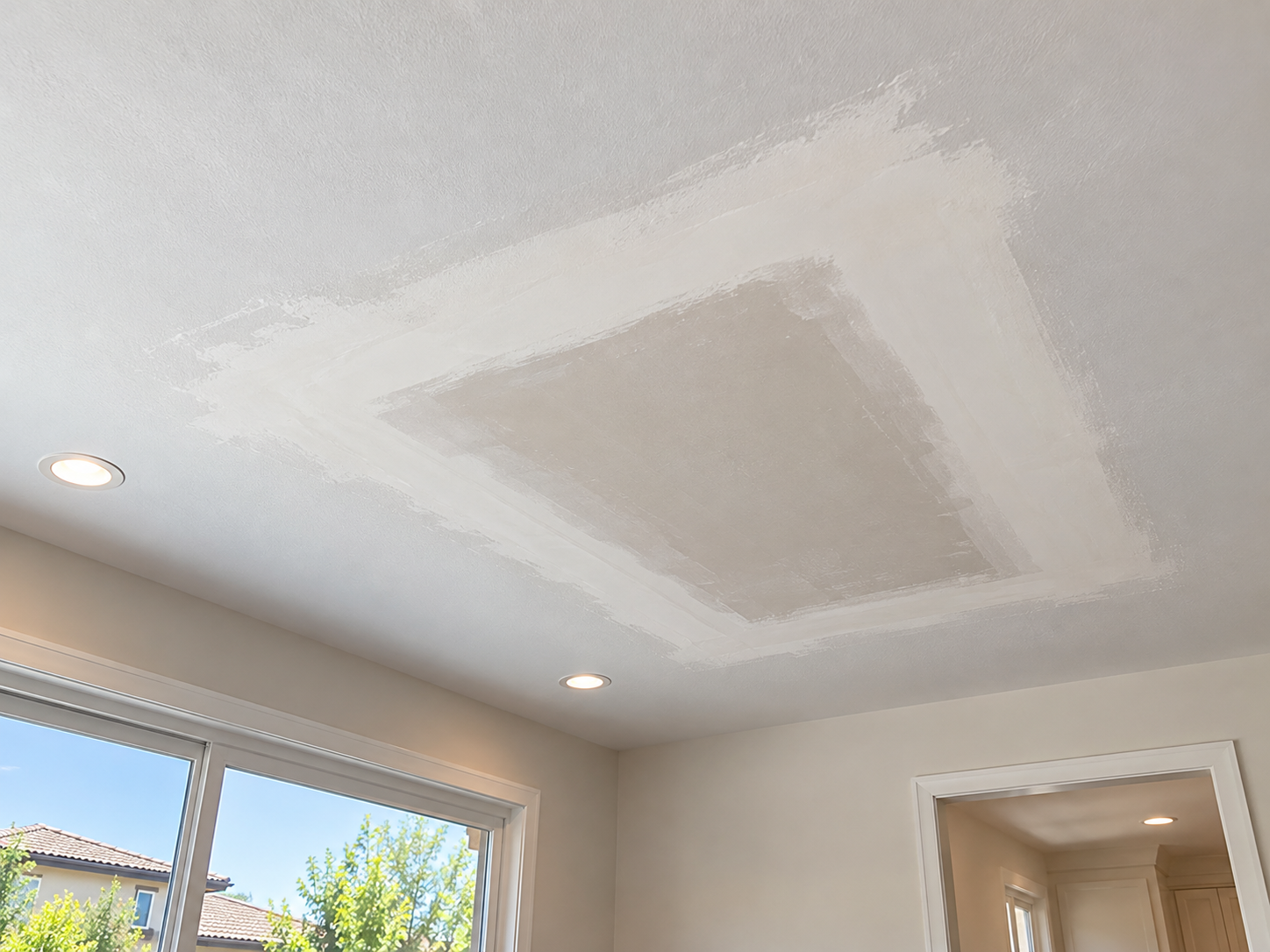
Plumbers, electricians, HVAC technicians, and other trades sometimes need to cut openings in a ceiling to reach pipes, wiring, ductwork, valves, drains, or other components above the drywall.
Once that work is complete, the access opening can usually be repaired with new drywall.
The opening should be checked for adequate support before the replacement piece is installed. Depending on the location and framing, additional backing may be needed so the new drywall has a solid attachment point.
After the patch is installed, the joints are taped and finished with joint compound. The compound is feathered beyond the original opening so the repair transitions gradually into the existing ceiling.
For smaller wall or ceiling openings, see Drywall Hole & Patch Repair.
Ceiling Repair After Water Damage
Water-damaged ceiling drywall needs to be approached carefully.
The moisture source should be corrected first. Drywall repair should not be used to conceal an active plumbing leak, roof leak, or ongoing moisture problem.
Once the source has been addressed and the area has dried, the condition of the ceiling drywall can be evaluated.
Drywall may need to be removed if it has become:
- soft
- swollen
- sagging
- deteriorated
- badly stained
- structurally compromised
- separated from the ceiling framing
In some cases, a small area may remain solid enough for limited repair. In others, partial ceiling replacement is the more appropriate option. Deciding between the two is a central part of drywall ceiling repair Irvine CA projects.
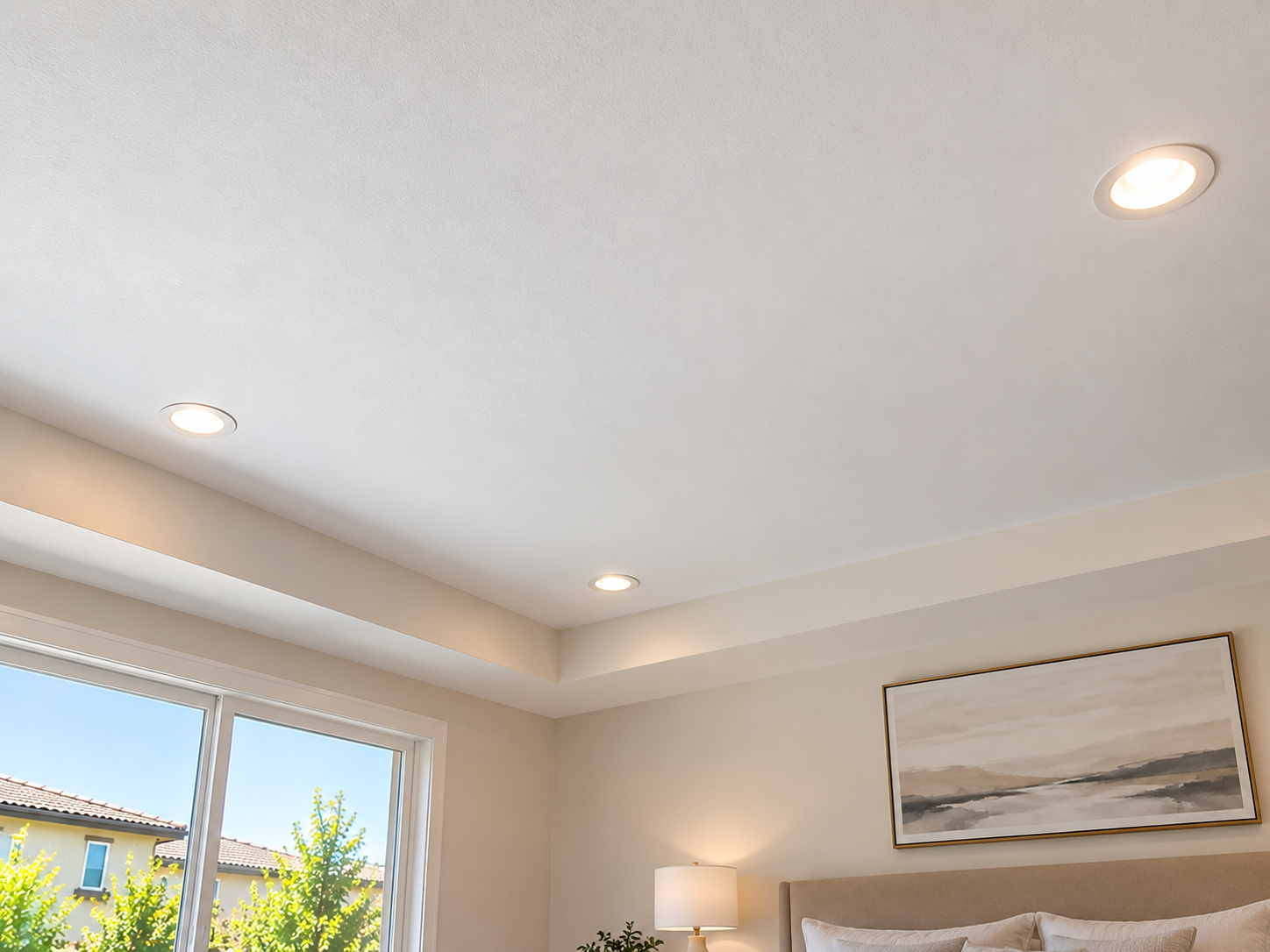
A finished water-damage repair should restore the ceiling plane and eliminate the visible boundary between the replacement section and the surrounding drywall.
For more information about moisture-related drywall work, visit Water Damage Drywall Repair.
Ceiling Cracks and Joint Damage
Ceiling cracks can develop for several reasons.
Some occur along drywall joints. Others appear near corners, changes in ceiling height, framing transitions, doors, or areas where normal building movement places stress on the finish.
Simply filling the visible crack is not always enough, especially in drywall ceiling repair Irvine CA homeowners want to last.
If tape has failed or the joint underneath the crack is unstable, the damaged area may need to be opened, retaped, reinforced, or refinished before the surface is blended back into the ceiling.
The objective is to address the damaged finish rather than repeatedly cover the same visible line.
Ceiling cracks should also be evaluated in context. A recurring or unusual crack may point to movement or another underlying condition outside the scope of cosmetic drywall finishing.
When Should Ceiling Drywall Be Patched vs. Replaced?
A small, stable damaged area can often be patched. Partial replacement may make more sense when the ceiling drywall itself has lost integrity. Choosing correctly between the two is a key part of drywall ceiling repair Irvine CA work.
A ceiling patch may be appropriate when:
- the damaged area is relatively small
- surrounding drywall remains firm
- the board has not softened from moisture
- there is adequate support around the repair
- the problem can be corrected without leaving an unstable section
Partial ceiling replacement may be more appropriate when:
- drywall is soft or deteriorated
- a large section has been removed
- water damage has weakened the gypsum core
- the board is badly cracked or broken
- sagging has damaged the sheet
- several nearby patches would create a larger irregular repair area
For larger drywall replacement or new ceiling work, visit Drywall Installation.
Matching Ceiling Texture After a Repair
Texture matching is one of the most important visual parts of ceiling repair.
A patch can be flat and structurally sound but still remain obvious if the repaired texture does not match the surrounding ceiling.
Existing Irvine ceilings may have:
- light orange peel
- knockdown
- subtle sprayed texture
- heavier stipple
- smooth finishes
- previously painted texture
Matching texture involves more than identifying the general pattern.
The scale, density, height, spacing, and transition into the existing finish all affect how visible the repaired area becomes.
A new texture may stand out if it is:
- heavier than the surrounding finish
- too fine
- too coarse
- applied over too small an area
- stopped abruptly at the patch edge
- inconsistent in density
The goal is to blend the new finish gradually into the original ceiling so the repaired area does not create a visible island of different texture.
Why Flatness Matters on a Ceiling
Ceilings are unforgiving surfaces.
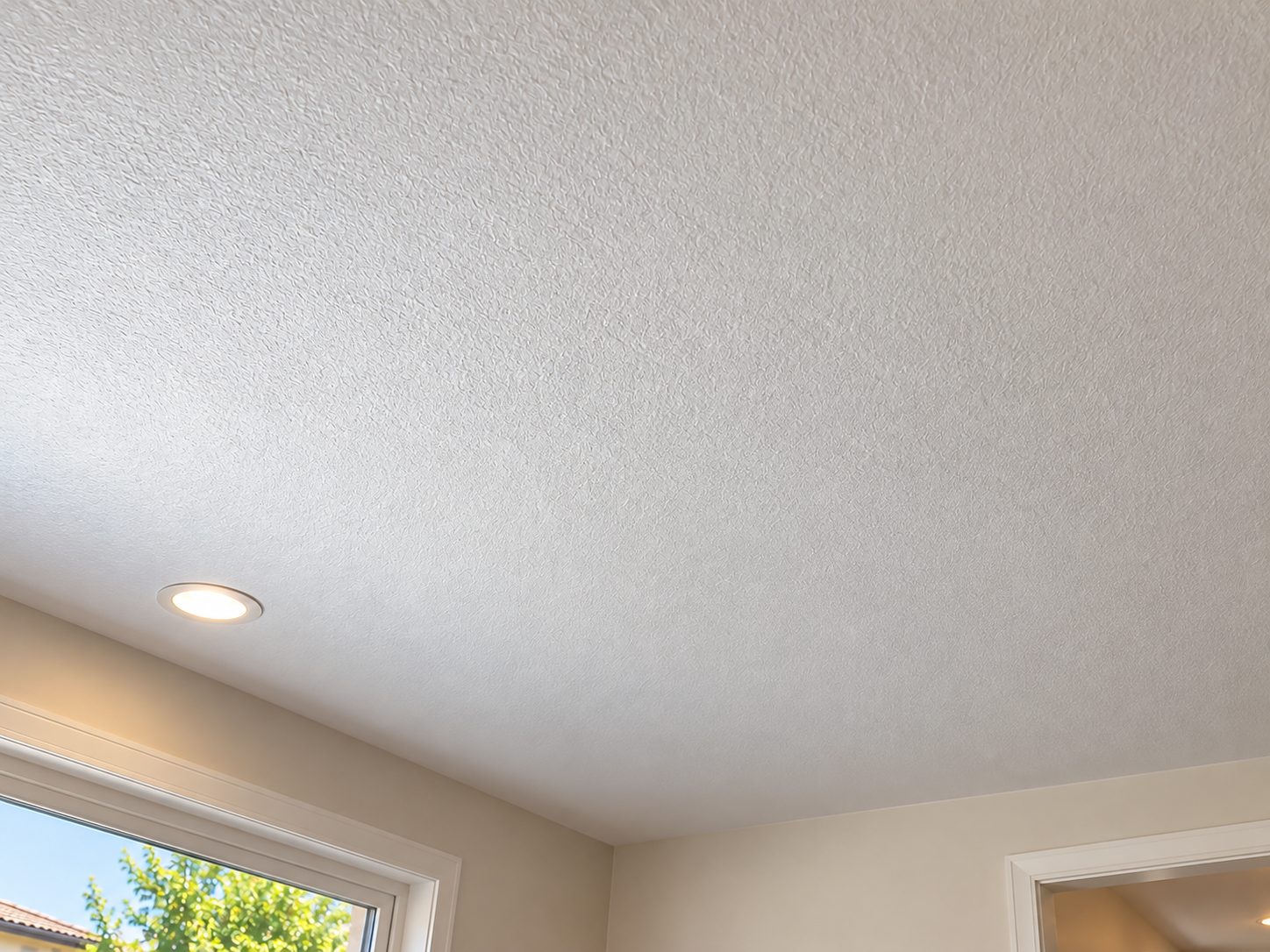
A repair can look flat when viewed directly from below but become obvious when daylight crosses the room.
A raised patch creates a hump. Excessive sanding can create a shallow depression. Either can cast subtle shadows when light travels across the ceiling.
This is why ceiling repair often requires broader finishing than the original opening might suggest.
The damaged area may only be a few inches or a few feet across, but the finished repair can extend farther so the compound can taper gradually into the surrounding ceiling.
For drywall ceiling repair Irvine homes need, the objective is not to make the patch itself disappear by adding more material. The objective is to restore the ceiling plane so the repair visually blends into the larger surface.
Our Drywall Ceiling Repair Process
1. Assess the Ceiling Damage
The first step is determining what is damaged and whether the surrounding drywall remains sound.
The repair approach changes depending on whether the problem involves a crack, hole, access opening, failed joint, water-damaged section, or larger area of compromised drywall.
2. Prepare the Area
Loose or deteriorated drywall is removed as needed.
If the repair requires a replacement piece, the opening is prepared so the new section has adequate backing and support.
3. Install and Finish the Patch
New drywall is fitted where required.
The joints are taped and coated with joint compound. Multiple coats may be needed depending on the size of the repair and the depth of the surrounding surface.
4. Feather and Sand
Joint compound is feathered beyond the patch so the transition becomes gradual rather than abrupt.
Once dry, the area is sanded and checked for flatness.
5. Match the Ceiling Texture
If the existing ceiling has texture, the repaired section is blended to match the surrounding finish as closely as practical. That blending is one of the finishing details that separates a seamless drywall ceiling repair Irvine CA project from a visible patch.
6. Prepare for Primer and Paint
Each drywall ceiling repair Irvine CA project ends with the completed repair left ready for the appropriate finishing steps.
In drywall ceiling repair Irvine CA homes need, fresh joint compound and exposed drywall typically absorb coatings differently than previously painted surfaces, so proper priming is important before the finish coat.
Drywall Ceiling Repair Throughout Irvine
Irvine Drywall provides drywall ceiling repair Irvine CA property owners can ask about throughout the city, including areas such as:
Woodbridge, Northwood, Northwood Point, Woodbury, Stonegate, Cypress Village, Orchard Hills, Portola Springs, Great Park, Quail Hill, Turtle Rock, Turtle Ridge, University Park, Westpark, Oak Creek, Los Olivos, Rancho San Joaquin, and surrounding Irvine neighborhoods.
We serve Irvine ZIP codes including 92602, 92603, 92604, 92606, 92612, 92614, 92617, 92618, and 92620.
If you are searching for drywall ceiling repair Irvine CA homeowners can rely on, or drywall ceiling repair near me and the damaged ceiling is in Irvine, call or send the project details through our Contact / Fast Quote page.
Drywall Ceiling Repair FAQs
How much does drywall ceiling repair cost in Irvine?
Drywall ceiling repair cost depends on the size and location of the damage, whether drywall replacement is required, access to the repair area, the amount of finishing needed, texture matching, and the condition of the surrounding ceiling.
A small localized patch is different from a larger ceiling section that needs replacement and extensive finishing.
For more information about pricing factors, visit Drywall Repair Cost.
Can you repair a ceiling hole left by a plumber or electrician?
Yes. After the plumbing, electrical, or other trade work is complete, a ceiling access opening can typically be closed with new drywall and finished to blend into the surrounding ceiling.
The repair may require backing, new drywall, taped joints, multiple coats of compound, sanding, and texture matching.
Can water-damaged ceiling drywall be repaired?
Sometimes.
The water source should be corrected first and the area should be dry before drywall repair begins.
Drywall that remains firm may require limited repair, while soft, sagging, deteriorated, or compromised material may need to be removed and replaced.
Can a repaired ceiling match the existing texture?
Often, yes.
The closer the new texture matches the scale, density, pattern, and application of the existing ceiling, the less visible the repaired area will be.
Lighting and the age of the existing finish can also affect how closely the final repair appears.
Why can I still see an old ceiling patch?
Old ceiling patches often remain visible because the repair was not feathered widely enough, the surface is raised or depressed, the texture does not match, or the primer and paint finish differs from the surrounding ceiling.
Strong side lighting can make these differences much easier to see.
How long does a drywall ceiling repair take?
Repair time depends on the size and complexity of the damage.
Joint compound may require multiple coats and adequate drying time between stages. Larger patches, texture matching, and water-damage replacement can require more steps than a small localized repair.
Do ceiling repairs need primer before painting?
Fresh joint compound and exposed drywall usually absorb paint differently than an existing painted ceiling.
Proper priming helps create a more uniform surface before the final paint finish is applied.
Need Drywall Ceiling Repair in Irvine?
Whether the ceiling has a hole, crack, plumbing access opening, previous water damage, failed joint, or damaged section that needs replacement, the finished repair should restore a flat ceiling plane and blend naturally with the surrounding surface.
Get a Fast Quote for Drywall Ceiling Repair in Irvine
To get started with drywall ceiling repair Irvine CA, call (949) 850-3172 or use our Contact / Fast Quote page to tell us about the ceiling damage.